

From Sketch to Puppet
Puppet Theatre FRU-FRU: Jerica Cvetko, Anja Gruden, Marina Hrovatin, Petra Petan, Peter Škerl
Presentation of Puppet Theatre FRU-FRU and Jerica Cvetko, Anja Gruden, Marina Hrovatin, Petra Petan and Peter Škerl, a doorway for young visitors into imagination and their first encounter with theatre, where puppets, music, and performances of beloved fairy tales and contemporary stories come together.
The annual exhibition From Sketch to Puppet, which under the careful organisation of Bežigrad Gallery 1 has been delighting and informing generations of visitors since 1980, a tradition of more than four decades, presents both the art of puppetry and the artists who have devoted their careers to this form of performance for children and others.
Puppet Theatre FRU-FRU began its journey in 1984, as a puppet theatre group working within the Pionirski dom puppet ensemble under the guidance of writer and educator Lojze Kovačič. In the 1980s, the ensemble was among the leading puppet groups in what was then Yugoslavia, distinguished by its innovative and experimental performances for both children and adults. From its creative core emerged the FRU-FRU group, devoted to creating theatre for children. In its original formation—Irena Rajh, Ava Lokošek, Andreja Hočevar, Barbara Bulatovič and Mateja Bizjak—the group created five productions.
FRU-FRU was among the first touring theatres in Slovenia. Its performances came out of suitcases: modest in their scenography, rich in imagination, playful, communicative and able to adapt to almost any space. A classroom, a kindergarten, a small hall—wherever there was an audience, there could be a stage. From its very first year, the group travelled throughout Slovenia, using the funds it earned to support its experimental projects and performances for adults. In 1993, FRU-FRU became the professional family theatre of Irena Rajh and Marjan Kunaver. It soon grew into a repertory theatre involving more than thirty collaborators. Over the course of more than three decades, it has developed a distinctive language of puppetry and an extensive repertoire of performances for children.
At the heart of FRU-FRU's work is the puppet: an object that, through the touch of the animator, enters the realm of theatre and begins to live. The theatre's performances bring together diverse puppet techniques, object animation, acting, music and visual art. Puppets and sets are created through encounters between puppeteers, visual artists, directors, musicians, writers and many other collaborators. Each performance is thus the result of a shared act of creation—a meeting of materials, hands, voices and imaginations.
FRU-FRU creates performances for children of different ages, with particular care given to its youngest spectators. Each production grows from a dialogue between story, visual concept, the possibilities of animation and the immediate presence of the audience. The performances are conceived to be accessible, communicative and adaptable, able to move freely between theatre halls, kindergartens, schools and cultural centres.
For more than three decades, FRU-FRU has travelled throughout Slovenia and to Slovene communities beyond its borders. It has appeared at national and international festivals and received numerous awards. Across the years, it has worked with artists from many generations, preserving an open space for new approaches, new collaborators and the continuing development of puppet theatre for children.
The theatre's work extends beyond the performances themselves. FRU-FRU has been an active participant in cultural programmes, festivals and events, contributing to the cultural life of Ljubljana and communities throughout Slovenia.
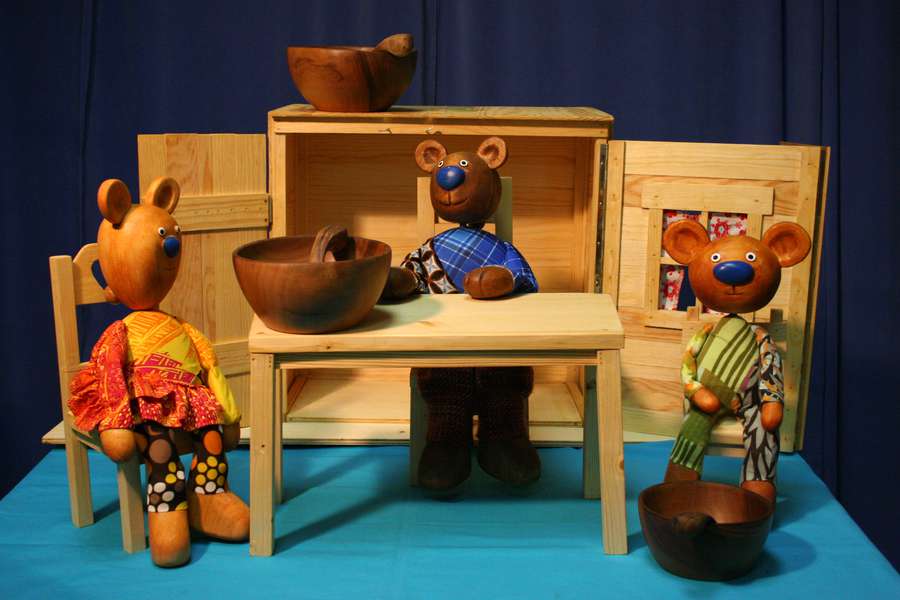
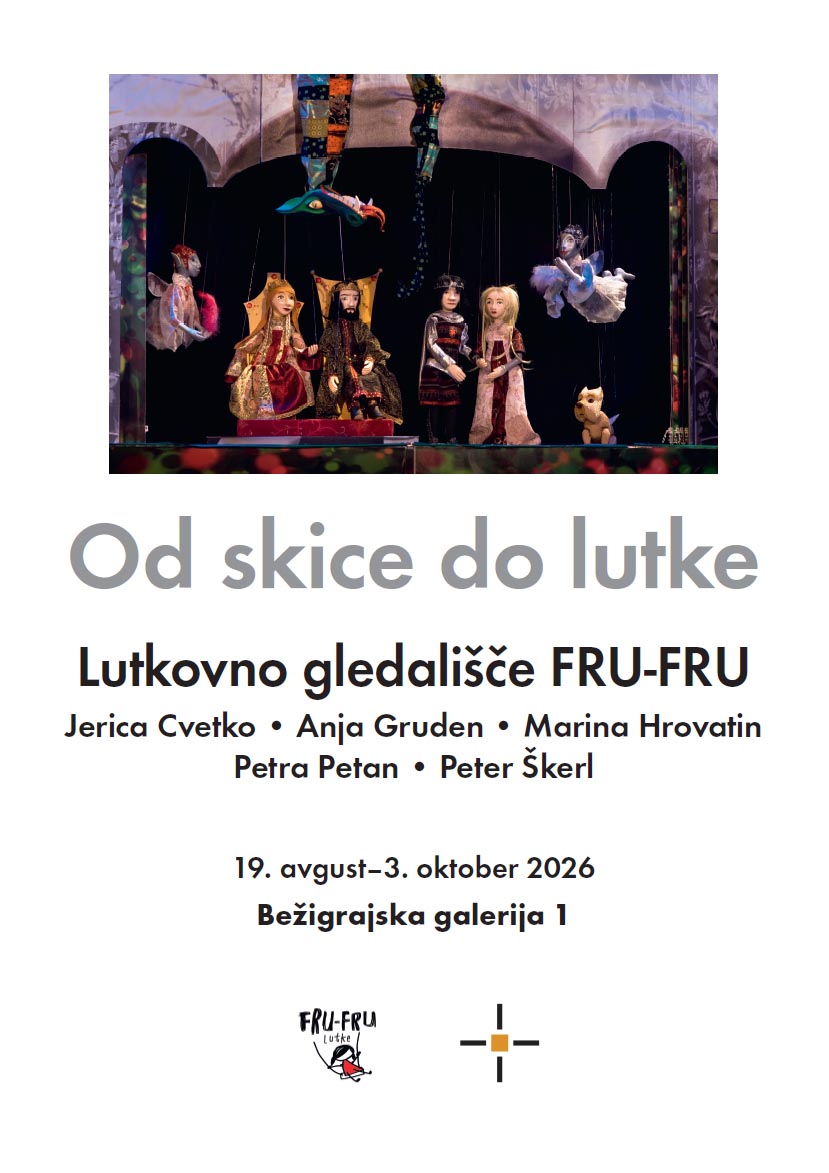
This exhibition presents a selection of puppets, sets and other materials from past productions. These objects bear witness to the theatre's development, its creative processes and the many forms that puppetry can take. They offer a glimpse behind the curtain, into the work that usually remains unseen: the shaping of a visual world, the making of a puppet, the mechanisms of its movement, the construction of a set and the process of performance coming to life.
The history of Puppet Theatre FRU-FRU is the history of more than three decades of professional work with children and for children. Its performances continue to live on in the theatre's puppet collection and repertoire, but also in the memories of the many generations of spectators.
The visual design of a puppet performance emerges from a number of interconnected elements: the story, the chosen puppet technique, the performance space, the age of the audience and the way the performance is played. In developing designs, puppets and scenography, it is essential that the visual language supports the content of the performance while also allowing for clear animation, recognisable characters and direct communication with the audience.
In puppet theatre, the visual design is not merely the frame surrounding a performance. It is one of its fundamental building blocks. The shape of a puppet, the choice of materials, the relationship between the size of the puppet and the performer, as well as colour, texture and mobility, all influence how the audience understands a character and its role within the story. A puppet must be visually recognisable, while also remaining sufficiently functional to allow for animation, play and contact with the audience.
The puppets in FRU-FRU’s performances are created using a variety of techniques and materials. Their design is adapted to the character of each individual figure, the dramaturgy of the performance and the manner in which it is animated. Some puppets are conceived as independent characters; others emerge from objects, materials or simple forms that, through animation on stage, become carriers of the action. In each case, the relationship between the visual idea and its practical use on stage is essential.
Scenography, too, is often more than a backdrop in puppet theatre. It can become a playing space, a hiding place for puppets, a mechanism for transformation or part of the narrative itself. Scenographic elements may open, move, come together, come apart or change their function. The scenography must therefore be conceived in a way that brings together the visual language of the performance with its technical and theatrical demands.
A distinctive feature of puppet theatre is the close relationship between visual design and performance. A design for a puppet or a piece of scenography is not merely a drawing or a visual idea, but a point of departure for movement, animation, rhythm, play and storytelling. As a performance takes shape, the visual solution often develops alongside the direction, music, dramaturgy and the work of the animators.
The exhibition reveals a part of this creative process: from initial ideas, sketches and visual designs to completed puppets, scenographic elements and their use in performances. The materials on display offer a glimpse into the work that usually remains behind the stage, while also revealing the essential role that visual design plays in shaping a puppet performance.
Anže Virant
Colophon
Production: Bežigrajska galerija 1 / MGML
Exhibition curator: Miloš Bašin
Authors: Jerica Cvetko, Anja Gruden, Marina Hrovatin, Petra Petan, Peter Škerl
Design: Miloš Bašin
Text: Anže Virant, Miloš Bašin, Marina Mihelič Satler
Tehnical design: Marko Tušek
Photodocumentation: Žiga Koritnik
Translation: Dunja Elikan
Language editing: Dunja Elikan
Promotion: Marina Mihelič Satler
Realisation of the exhibition: Miloš Bašin, Irena Rajh, Ula Tušek, Anže Virant
The exhibition was made by: City of Ljubljana
Location
Dunajska 31
1000 Ljubljana
T +386 1 43 66 957
F +386 1 43 66 958
E bezigrajska.galerija1.2@gmail.com
Opening hours
Tuesday to Friday: 10:00–18:00
Saturday: 10:00–14:00
Sundays, Mondays: Closed
24 and 31 December: 10:00–14:00
1 January, 1 November, 25 December: Closed
Tickets
Free entry.