From private house to public bath
New research at the NUK II site
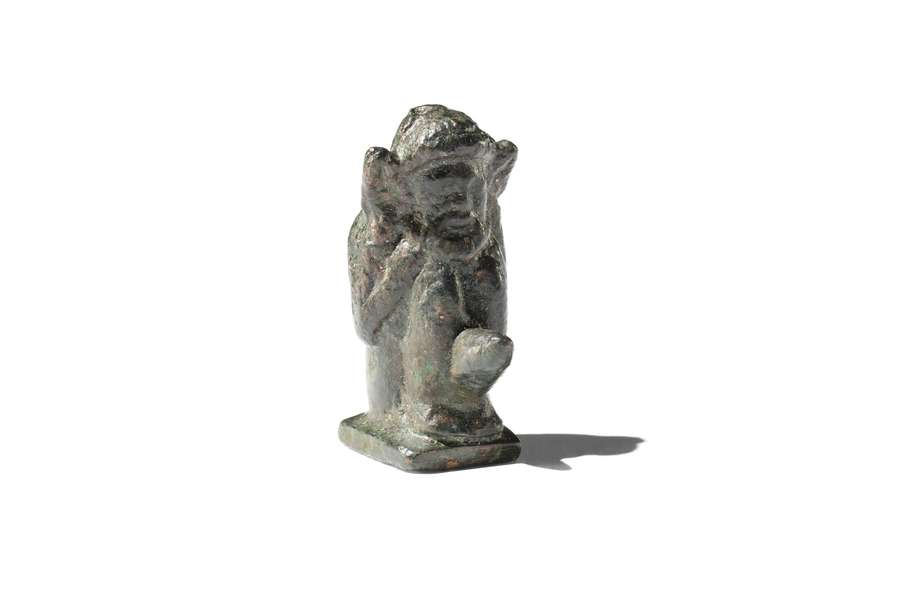
The exhibition in the museum Treasury is dedicated to presenting archaeological finds from the excavations at the new National and University Library (NUK II) site, conducted in 2024 and 2025 by the ZVKDS, Centre for Preventive Archaeology (CPA). On display will be several particularly interesting small finds, among which stands out a small bronze figurine of Priapus, the deity of fertility and the protector of livestock and gardens.
Archaeological investigations in the area of the planned new National and University Library (NUK II) have been ongoing since the early 1990s. After extensive excavations between 1996 and 1999 and supplementary research in 2008, archaeologists explored the final previously inaccessible section between October 2024 and April 2025. This 520 m² area lay inside the walls of the former Roman city of Emona, near the eastern city gate. It included the central parts of Insula XXVII and Insula XLVI and the road between them, which crossed the city along the Siscia–Aquileia route.
Pre-Emonan military camp and the construction of the city
The oldest traces indicate that before the founding of Emona the area was used by the Roman army, which established a camp here, as shown by the remains of a defensive ditch as well as hearths and pits for food preparation. Around AD 14, at the beginning of the city’s construction, the investigated terrain was levelled and used for storing building material.
Two simple residential buildings
After the construction of Emona, two residential houses stood on this spot. The rooms of Insula XLVI were arranged around a courtyard with a well, and drainage channels were documented that carried rainwater from the roofs of the courtyard towards the Ljubljanica River. The neighbouring Insula XXVII was much more poorly preserved. In the investigated area there was a courtyard with a colonnade, paved with simple floors, mostly pebble surfaces or thin mortar layers. Postholes for vertical supports indicate that the rooms were partitioned with wooden walls, while the remains of furnaces suggest probable craft activity in the spaces.
In the mid-1st century, during the reign of Emperor Claudius, Emona first received a sewer system and somewhat later also a water supply. This was followed by changes in the function and layout of the rooms in both insulae. A basin was also added, indicating the beginning of the transformation of a private space into a public bath.
Public bath complex
At the end of the 3rd or the beginning of the 4th century, a major renovation followed. The road between the insulae was built over, the two were merged into a unified public bath complex and completely reorganised. Heated rooms were created with a hypocaust, brick pillars and slabs supporting a mosaic floor made of small black and white stone tesserae, as well as a larger pool (at least 22 m²) with a very solidly built shell and smaller semicircular endings along the sides, intended for bathing in unheated water. Traces of repairs and renovations were also discovered, attesting to the long-term use of the building.
Figurine of Priapus
Among more than 12 tonnes of recovered material, a tiny bronze figurine of the god Priapus, barely three centimetres high, stands out. According to ancient belief, his image warded off evil and therefore often accompanied the daily life of inhabitants of Roman cities. They venerated him as a guardian of fields and homes and as a symbol of the fertility of land, animals and people.
Colophon
Production: Museum and Galleries of Ljubljana
Curator: dr. Bernarda Županek
Text: Blaž Orehek (CPA ZVKDS)
Production and coordination: Ana Kure
Professional assistance in exhibition installation: mag. Katarina Toman Kracina
Conservation and restoration: Robert Koračin (ZVKDS, Restavratorski center), Nežka Faganel, Helena Pucelj Krajnc (MGML)
Photography and videos: Tomaž Jerina, Tjaž Zorman (ZVKDS Restoration Centre), Blaž Zgaga (Arhej d. o. o.), Blaž Gutman (MGML)
Language editing (SLO): Katja Paladin
Translation: Polona Mesec
Graphic design: Bojan Lazarevič, Agora Proars
Technical production and layout: O.K.VIR, Tehnična služba MGML
Concept and development of the View from the Other Side digital platforn: Specto, mag. Katarina Toman Kracina, Nejc Kovačič
Content accessible via QR code: Robert Koračin (ZVKDS), Nežka Faganel, Helena Pucelj Krajnc, mag. Katarina Toman Kracina (MGML)
PR and marketing: Tesa Arzenšek, Nejc Kovačič
Location
Gosposka 15
1000 Ljubljana
Information and reservations:
T: +386 1 2412 500
T: +386 1 2412 506
E- mail: info@mgml.si, prijava@mgml.si
Opening hours
Tuesday–Sunday: 10.00–18.00
Mondays, 1 January, 1 November and 25 December: Closed
Tickets
Permanent exhibition Ljubljana. History. City. (basement and 2nd floor)
Solo visit: € 8 / reduced (children from the age of 7, students, over 60, unemployed, disabled): €6
Family ticket: 18€
Public guided tour: € 9.00 / reduced: € 7.00
Children up to the age of 6, ICOM, PRESS, SMD, disabled companions, tourist URBANA, licensed tourist guide: free of charge