Fragments of Time
Contemporary Archaeological Research
Are you interested in how an object from the depths of the earth makes its way into a brightly lit museum display case?
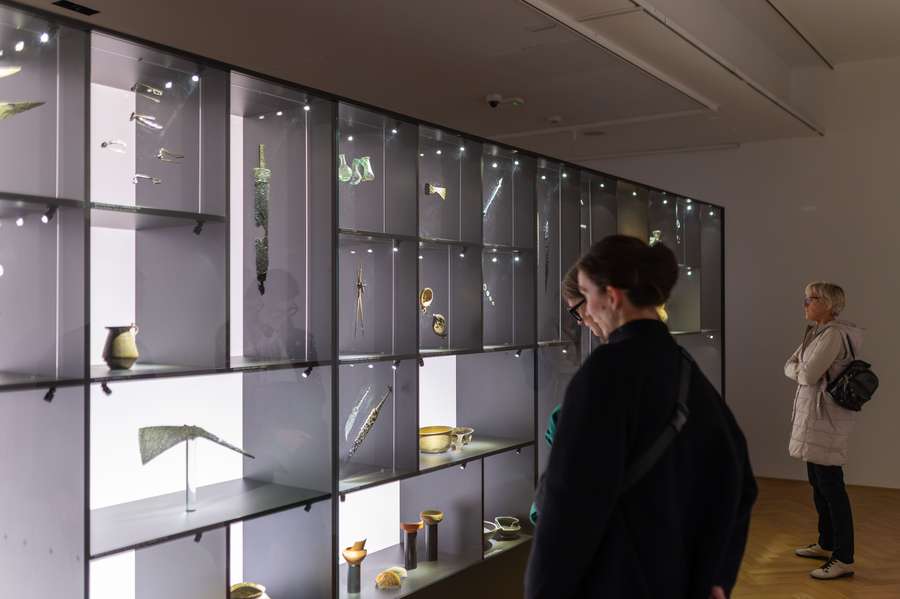
The exhibition Fragments of Time takes you behind the scenes of contemporary archaeological research, revealing that archaeology today is no longer simply about searching for lost treasures. It is a high-tech, interdisciplinary and collaborative science that helps shape our shared cultural identity. Drawing on examples of archaeological investigations carried out in Ljubljana and its surroundings over the past twenty years, the exhibition traces the entire journey of archaeological heritage – from discovery and excavation to complex laboratory analyses, conservation, scientific findings, museum display and the long-term storage of extensive archaeological site archives. It also highlights the importance of protecting archaeological heritage and our shared responsibility to preserve it for future generations.
Discover how archaeologists uncover hidden traces of the past
Today, advanced technologies allow archaeologists to identify traces of former settlements, buildings and other archaeological remains without turning a single spadeful of earth. LiDAR (Light Detection and Ranging) uses laser scanning to reveal the precise contours of the terrain beneath dense vegetation, ground-penetrating radar (GPR) allows archaeologists to look beneath the surface, and sonar reveals what lies underwater. When excavation is unavoidable, meticulous documentation is essential, as every excavation is an irreversible intervention in an archaeological site.
Find out what happens to archaeological finds after excavation
Discovering an object is only the beginning of a lengthy research process. Finds must be carefully cleaned, documented, studied and appropriately protected against deterioration. Preserving objects made from fragile materials, such as wood and textiles, is particularly challenging. These may have survived for centuries or even millennia in waterlogged soil, only to begin deteriorating rapidly when exposed to air. Specialists use X-ray fluorescence analysis (XRF), FTIR spectroscopy, computed tomography (CT), 3D scanning and other modern methods to study and preserve these objects.
Discover what archaeological finds can tell us about the past
Archaeological finds alone tell only part of the story. It is only by combining finds and field documentation with the results of scientific analyses of plant and animal remains, human skeletons and other material traces that we can gain insight into the lives of people who inhabited this region centuries or even millennia ago. Every new discovery deepens our understanding of past communities, their relationship with the environment, and the social and cultural development of the region in which we live today.
Step behind the scenes of archaeological research and connect the fragments of time with us!
Colophon
Museum and Galleries of Ljubljana, represented by: Blaž Peršin, Director
Project Partners:
Institute for the Protection of Cultural Heritage of Slovenia and University of Ljubljana, Faculty of Arts, Department of Archaeology
Project Manager: Martin Horvat
Exhibition Concept: Irena Šinkovec
Authors: Nežka Faganel, Andrej Gaspari, Martin Horvat, Katja Kavkler, Paola Korošec, Martina Lesar Kikelj, Helena Pucelj Krajnc, Špela Saje, Irena Šinkovec, Metka Štrajhar, Katarina Toman Kracina, Petra Vojakovič, Bernarda Županek
Expert Contributors: Branko Mušič, Ines Nabernik Bošnjak, Matija Skrt
Conservation of Exhibited Artefacts:
MGML Conservation Service: Matjaž Bizjak, Alenka Drol, Nežka Faganel, Paola Korošec, Helena Pucelj Krajnc, Zala Rebernak, Mojca Zver
ZVKDS Restoration Centre: Rok Dolničar, Mateja Kavčič, Katja Kavkler, Jelka Kuret, Robert Kuret, Martina Lesar Kikelj, Ajda Mladenovič, Nuša Saje, Roza Šantej, Anja Urbanc, ZVKDS Restoration Centre Technical Team
Photographs: AC MGML Archives, RC ZVKDS Archives, Arhej, Grega Babič, David Badovinac, Branko Cvetkovič, Branko Čeak, Oskar Karel Dolenc, Ladislav Duranka, Nežka Faganel, Andrej Gaspari, Jure Gasparič, Blaž Gutman, Tadej Hrženjak Tominc, Katja Kavkler, Marko Kočevar, Maja Lavrič, Matija Lukić, Rene Masaryk, Branko Mušič, Ines Nabernik Bošnjak, Matevž Paternoster, Sašo Poglajen, Helena Pucelj Krajnc, Borut Slokan, Bojan Zakeršnik
Video Material: Archives of the School of Engineering and Architecture (Lucerne University of Applied Sciences and Arts), MGML Archives, Archives of the Department of Wood Science and Technology (Biotechnical Faculty, University of Ljubljana), Stik Group Archives, Slovenian National Building and Civil Engineering Institute Archives
Visual Materials with Interpretation: Jaka Burja, Andrej Gaspari, Luka Gruškovnjak, Lidija Korat, Branko Mušič, Sašo Poglajen, Agni Prijatelj, Barbara Šetina Batič
Authors and Sources of Cartographic Materials: Delavnica, oblikovanje prostora, GIS KD, GURS
Scientific Sources:
Research Project: The Proto-Urban Hillfort of Pungrt Above Ig: From 10 Hectares to 10 Microns (ARIS J6-3126)
Research Project: MATRES – Material Resilience in Times of Environmental and Social Changes (UL VIP, ARIS, RSF-A, SN-ZRD/22-27/510)
Research Project: Investigating plant use and culinary choices at Slovenian pile-dwelling sites from 5th, 4th and 3rd millennium BC (Department of Archaeology, BioArCh, University of York, United Kingdom)
Educational Programmes:
Authors of Interactive Content: Damjana Bergant, Nika Damjanovič, Ema Marinčič
Expert Contributors: Helena Pucelj Krajnc, Sara Štorgel, Katarina Toman Kracina
Illustrations: Katarina Toman Kracina
Production of 3D Replicas: Damjana Bergant
Sources of 3D Replicas: Grey Wolf, Canis lupus (Linnaeus, 1758). Original scan, specimen: 170753, Mammal Research Institute, Polish Academy of Sciences. 3D printing model: Miriam Gutt. License: CC BY 4.0
Roe Deer, Capreolus capreolus (Linnaeus, 1758). Original scan, specimen: MZB 2002-0516, Museu de Ciències Naturals de Barcelona. 3D scan: Aida Parres Lluch, 2016. License: CC BY 4.0
Educational Programmes for Families, Kindergartens, and Schools: Damjana Bergant, Nika Damjanovič, Ema Marinčič
Children's Guide: Nika Damjanovič, Jaka Vukotič, UD design
Adult Education Programmes: Janja Rebolj
Design: Delavnica, oblikovanje prostora
Wall Illustrations: Katarina Toman Kracina
Proofreading: Katja Paladin (Slovenian), Leemeta (English)
Exhibition Equipment:
Delavnica, oblikovanje prostora, Društvo Tobiro, FABRIKAID, Mont line, POS plastika, RSN Media, Steklarstvo Kresal, Šivalnica Anamarija
Exhibition Layout & Installation:
MGML Conservation, Educational, and Technical Services; Delavnica, oblikovanje prostora, Mont line, RSN Media;
Tilen Horvat, Špela Saje, Jasmin Talundžić
Public Relations: Tesa Arzenšek
Marketing: Nejc Kovačič
Location
Gosposka 15
1000 Ljubljana
Information and reservations:
T: +386 1 2412 500
T: +386 1 2412 506
E- mail: info@mgml.si, prijava@mgml.si
Opening hours
Tuesday–Sunday: 10.00–18.00
Mondays, 1 January, 1 November and 25 December: Closed
Tickets
Permanent exhibition Ljubljana. History. City. (basement and 2nd floor)
Solo visit: € 10 / reduced (children from the age of 7, students, over 60, unemployed, disabled): € 8
Family ticket: € 22.00
Public guided tour: € 11 / reduced: € 9
Children up to the age of 6, ICOM, PRESS, SMD, disabled companions, tourist URBANA, licensed tourist guide: free of charge